Project Overview
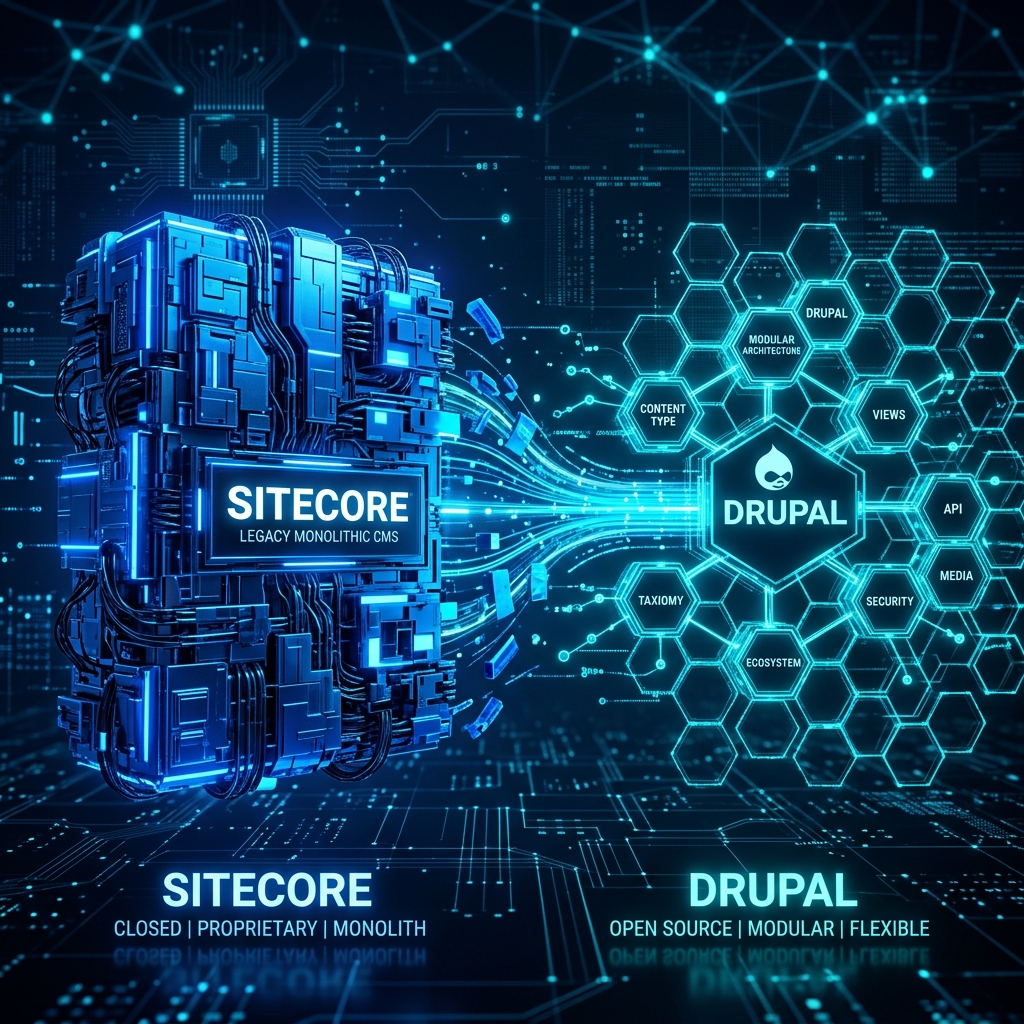
A leading financial bank needed to move a large, customer-facing website from Drupal 7 to Drupal 11 without sacrificing content fidelity, URLs, business functionality, visual consistency or security readiness. The team approached the problem as an agentic software-engineering program rather than a conventional sequential migration.
A lead AI orchestrator decomposed the work into specialized streams and coordinated five focused agents covering infrastructure and migration, theme and Twig reconstruction, forms and CRM integration, contributed modules and assets, and QA/security. Development and testing ran in parallel wherever dependencies allowed.
The Agentic Development Approach
The team created a multi-agent model with clear ownership boundaries. The lead/orchestrator was intentionally kept responsible for planning, dependency management, judgment and verification rather than delegating those decisions blindly.
- Infra & Migration: Build the Drupal 11 foundation, execute migration, configure database/search, preserve content and URL structure.
- Theme + Twig: Rebuild the presentation layer, recreating the legacy theme as Drupal 11 Twig templates.
- Forms & CRM: Rebuild interactive workflows and connect them to CRM/API endpoints using placeholders for secrets.
- Contrib & Asset: Address contributed/custom dependencies and restore missing images/assets.
- QA & Security: Continuously test and harden with page-level testing, visual comparisons, and security sweeps.
Parallel Build & Continuous QA
The Drupal 7 environment and a dated database dump were treated as read-only reference material. A clean Drupal 11 environment was established independently.
The Theme/Twig, Forms/CRM and Contrib/Asset agents worked in parallel on separate surfaces to minimize blocking. The QA/Security agent continuously exercised the site rather than waiting for a final hand-off. Findings from testing were converted into targeted fixes and then re-tested.
Have a similar challenge?
Our experts can help you build custom integrations and plugins tailored to your business workflows.
Key Challenges
Challenge 1
Drupal 7 code and content structures had to be understood before they could be transformed.
Challenge 2
The original site needed to remain a safe read-only reference and rollback source.
Challenge 3
The new implementation had to preserve customer-facing behavior and avoid introducing secrets into code.
Challenge 4
A conventional modernization path would have created a long critical path by staging frontend, integrations, and QA sequentially.
Results & Outcomes
The result was a near-production-ready Drupal 11 implementation with the major engineering workstreams completed in parallel and a visible evidence trail for verification. The overall project duration was an astounding 48 hours.
The real acceleration came from changing the unit of execution. The team compressed the critical path by turning one large migration project into several specialized, concurrently executing engineering loops. AI was used to increase throughput; orchestration and verification were used to keep the outcome controlled.