Project Overview
ForceHQ needed an automated AI proctoring system capable of detecting suspicious behaviors during remote assessments—specifically, whether a candidate is looking at a secondary monitor, reading off-screen notes, or receiving unauthorized help. After off-the-shelf computer vision models suffered from high false-positive rates due to unpredictable remote webcam environments (poor lighting, varied camera angles), ForceHQ realized they needed a custom model. To build a highly accurate model that could track subtle eyeball movements, neck rotation, and micro-expressions, they first required a meticulously labeled, bias-free dataset of facial landmarks.
Dense Facial Keypoint Annotation
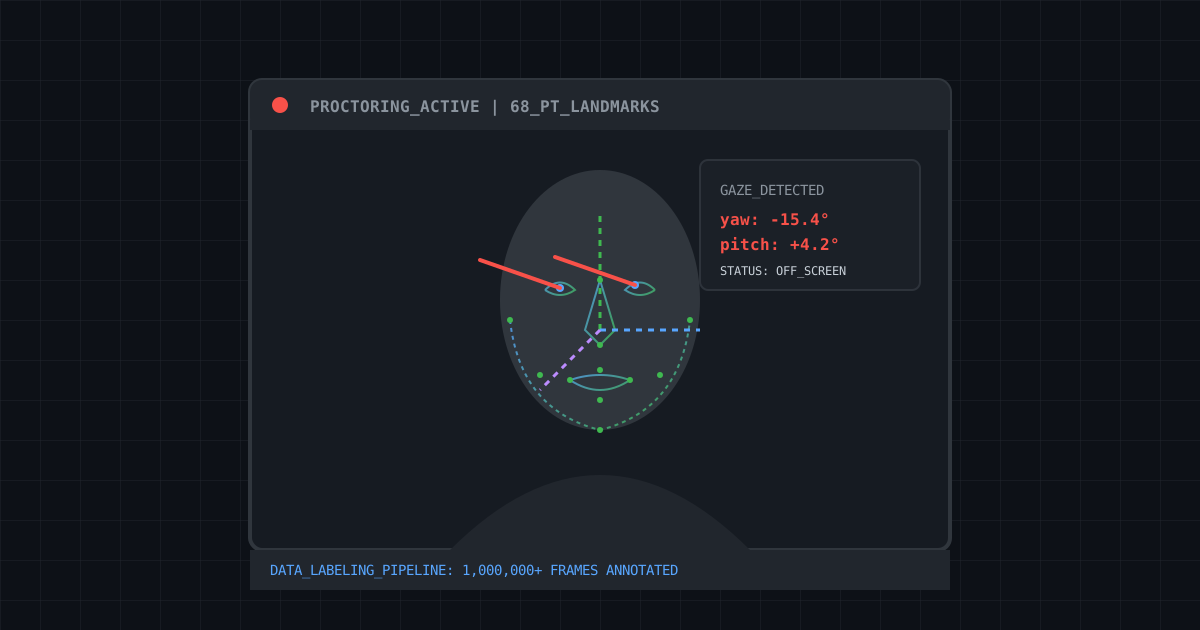
Our AI Data Labeling team processed thousands of hours of diverse webcam footage, mapping complex 68+ point facial landmarks to track eyes, nose, and jawline with pixel-perfect accuracy.
Gaze & Head Pose Labeling
We went beyond standard landmarks by annotating precise pupil vectors and calculating head pose orientations (pitch, yaw, roll) to establish baseline attention metrics.
Have a similar challenge?
Our experts can help you build custom integrations and plugins tailored to your business workflows.
Dataset Balancing & Bias Mitigation
Implemented rigorous QA workflows to ensure the dataset was heavily balanced across different skin tones, facial hair, glasses, and lighting conditions to completely eliminate algorithmic bias.
Custom Computer Vision Training
Using this high-fidelity labeled data, we successfully trained a custom computer vision model that accurately flags suspicious assessment behavior in real time while drastically reducing false positives.
Key Challenges
Challenge 1
Off-the-shelf models failed under the diverse and unpredictable conditions of remote webcams (low resolution, poor lighting, varied angles).
Challenge 2
Tracking subtle eyeball movements and neck rotation (pitch, yaw, roll) requires pixel-perfect, dense keypoint annotation.
Challenge 3
Algorithmic bias was a major risk; the dataset needed to perform equally well across diverse skin tones, facial features, and the presence of glasses.
Challenge 4
High false-positive rates in automated proctoring severely degrade the candidate experience, demanding exceptional model precision.