Software Engineering & Digital Products for Global Enterprises since 2006
CMMi Level 3SOC 2ISO 27001
View all services
Staff Augmentation
Embed senior engineers in your team within weeks.
Dedicated Teams
A ring-fenced squad with PM, leads, and engineers.
Build-Operate-Transfer
We hire, run, and transfer the team to you.
Contract-to-Hire
Try the talent. Convert when you're ready.
ForceHQ
Skill testing, interviews and ranking — powered by AI.
RoboRingo
Build, deploy and monitor voice agents without code.
MailGovern
Policy, retention and compliance for enterprise email.
Vishing
Test and train staff against AI-driven voice attacks.
CyberForceHQ
Continuous, adaptive security training for every team.
IDS Load Balancer
Built for Multi Instance InDesign Server, to distribute jobs.
AutoVAPT.ai
AI agent for continuous, automated vulnerability and penetration testing.
Salesforce + InDesign Connector
Bridge Salesforce data into InDesign to design print catalogues at scale.
HumanDISC
AI-powered behavioral assessments and DISC profiling for smarter hiring.
View all solutions
Banking, Financial Services & Insurance
Cloud, digital and legacy modernisation across financial entities.
Healthcare
Clinical platforms, patient engagement, and connected medical devices.
Pharma & Life Sciences
Trial systems, regulatory data, and field-force enablement.
Professional Services & Education
Workflow automation, learning platforms, and consulting tooling.
Media & Entertainment
AI video processing, OTT platforms, and content workflows.
Technology & SaaS
Product engineering, integrations, and scale for tech companies.
Retail & eCommerce
Shopify, print catalogues, web-to-print, and order automation.
View all industries
Blog
Engineering notes, opinions, and field reports.
Case Studies
How clients shipped — outcomes, stack, lessons.
White Papers
Deep-dives on AI, talent models, and platforms.
View all resources
About Us
Who we are, our story, and what drives us.
Co-Innovation
How we partner to build new products together.
Careers
Open roles and what it's like to work here.
News
Press, announcements, and industry updates.
Leadership
The people steering MetaDesign.
Locations
Gurugram, Brisbane, Detroit and beyond.
Contact Us
Talk to sales, hiring, or partnerships.
Request TalentStart a Project
AI & Machine LearningSports Broadcasting & Media

High-precision video frame annotation for a real-time YOLO model to detect and blur illegal stadium ads.

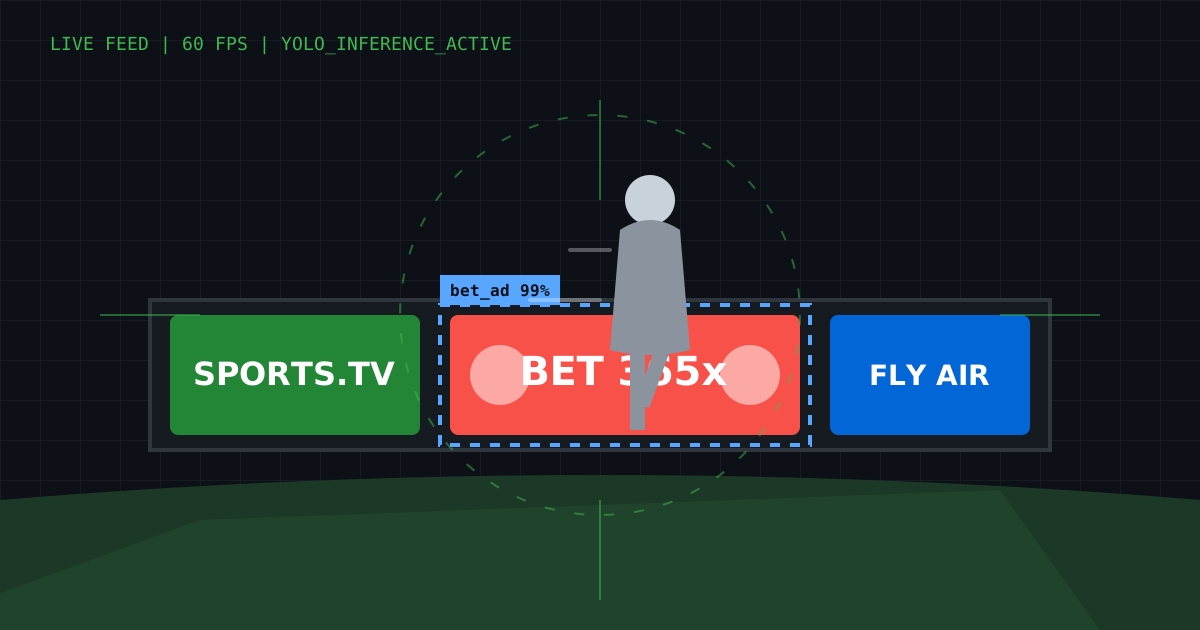
We orchestrated a comprehensive AI Data Labeling pipeline to annotate thousands of live sports video frames, enabling a custom YOLO model to blur illegal betting ads in real-time.

YOLOv8 · OpenCV · Python
Client: Major Sports Broadcasting Network
YOLO Data Labeling for Live Sports Video Blurring

Project Overview

Due to strict regional broadcasting regulations, the client was legally prohibited from showing betting and gambling advertisements during live sports feeds in specific countries. They required a real-time system to detect and blur these illegal advertisements on stadium perimeter boards. To build a custom YOLO model capable of inference at 60 FPS without lagging the live broadcast, they first needed a massive, highly accurate labeled dataset that accounted for the complexities of live sports footage.

Strategic Frame Extraction

We sampled hundreds of thousands of frames from varied historical sports broadcasts, specifically targeting edge cases like high-speed panning, player occlusions, and diverse lighting conditions.

Precision Video Annotation

Our AI Data Labeling team utilized CVAT and Label Studio to draw pixel-perfect bounding boxes and segmentation polygons around betting advertisements, meticulously adjusting for player overlaps and motion blur.

Have a similar challenge?

Our experts can help you build custom integrations and plugins tailored to your business workflows.

Book a free consultation

Multi-Tier QA Workflows

Implemented a strict 3-tier Quality Assurance process to eliminate false positives and ensure highly consistent labeling logic across the entire massive dataset.

Real-Time YOLO Inference

Using the high-quality dataset, we trained a custom YOLOv8 model optimized with TensorRT. We deployed a real-time inference pipeline that detects the ads and applies a Gaussian blur mask directly onto the live video feed at 60 FPS.

Key Challenges

01

Challenge 1

Rapid camera panning and zooming caused extreme motion blur on the background perimeter advertisements.

02

Challenge 2

Players constantly ran in front of the ad boards, creating complex partial occlusions that confuse object detection models.

03

Challenge 3

Varying stadium lighting conditions (daylight to artificial night lights) required diverse data representation.

04

Challenge 4

The final YOLO model had to run inference and apply the blurring mask in real-time (60 FPS) to avoid broadcasting delays.

Results & Outcomes

500k+
Frames Labeled
99.4%
Annotation Accuracy
60 FPS
Inference Speed
100%
Regulatory Compliance
FAQ

Frequently Asked Questions

Common questions about this topic, answered by our engineering team.
YOLO models learn exclusively from the provided dataset. If the bounding boxes are sloppy or fail to account for occlusions, the model will learn those bad habits, resulting in flickering detections or false positives during real-time inference.
We trained our annotation team to use tight polygons rather than simple rectangular bounding boxes when players stood in front of the ads. We also labeled heavily occluded ads (where only 10-20% of the ad was visible) so the model could learn to detect partial brand logos.
We utilized enterprise-grade annotation tools like CVAT (Computer Vision Annotation Tool) and Label Studio. These platforms allowed us to use interpolation features for moving cameras, significantly speeding up the frame-by-frame labeling process while maintaining high accuracy.
We implement a multi-tier QA workflow. Junior annotators do the initial labeling, senior reviewers perform random sampling and consensus checks, and we run automated scripts to detect anomalies like overlapping boxes or highly unusual aspect ratios before the data enters the training pipeline.
Once the YOLO model detects the coordinates of the illegal ad, we use OpenCV to apply a Gaussian blur mask exclusively to that bounding box region on the current frame. By optimizing the model with TensorRT, this entire detect-and-blur loop happens in less than 16 milliseconds per frame, achieving a smooth 60 FPS output.
Have a similar challenge?

Let's build your success story.

A 30-minute call with a principal engineer. We'll discuss your challenges, propose architecture, and outline a roadmap.

Talk to a strategist
Have a similar project? Let's discuss your requirements.
Book a call
EmailWhatsApp