


 MetaDesign Solutions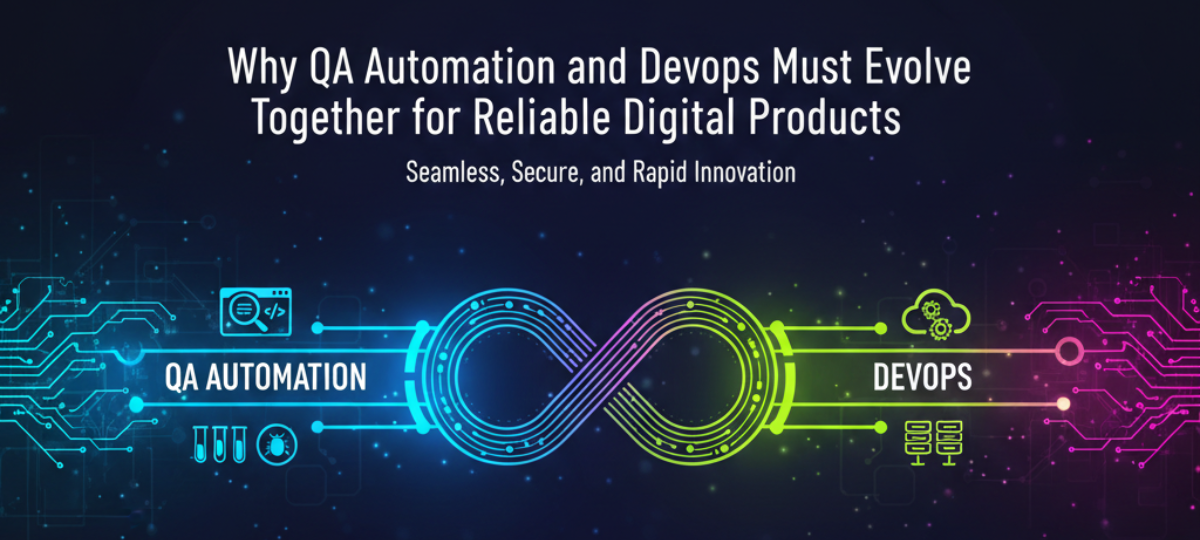

In 2026, digital products are no longer released quarterly — they are deployed daily. Modern enterprises rely on DevOps practices, CI/CD pipelines, and cloud-native architectures to accelerate delivery and remain competitive.
But speed without quality is dangerous.
Organizations that scale DevOps without evolving QA automation often experience unstable releases, production bugs, degraded user experience, and mounting technical debt.
The reality is simple:
Reliable digital products are built when QA Automation and DevOps evolve together — not separately.
This article explores why integrating QA automation into DevOps pipelines is critical for modern software development and how engineering leaders can build a unified quality-driven delivery ecosystem.
The Acceleration of Modern Software Delivery
Today’s digital ecosystem demands:
- Faster release cycles
- Continuous deployment
- Microservices architecture
- API-first platforms
- Cloud-native applications
- AI-driven systems
DevOps enables this velocity through:
- Continuous Integration (CI)
- Continuous Delivery (CD)
- Infrastructure as Code (IaC)
- Automated provisioning
- Containerized deployments
However, as deployment frequency increases, traditional manual QA processes cannot keep pace.
Without automated testing embedded into the DevOps lifecycle, release pipelines become fast — but fragile.
Understanding DevOps and QA Automation
What Is DevOps?
DevOps is a cultural and technical framework that unifies development and operations to:
- Shorten software development life cycles
- Improve deployment frequency
- Increase system stability
- Enhance collaboration
DevOps emphasizes automation, monitoring, and rapid feedback loops.
What Is QA Automation?
QA automation uses testing frameworks and tools to automatically validate:
- Unit functionality
- Integration behavior
- API contracts
- User interface flows
- Regression scenarios
- Performance benchmarks
- Security vulnerabilities
Automated testing reduces manual effort while increasing reliability and consistency.
The Risk of Treating QA as a Separate Function
Many organizations still treat QA as a final validation phase instead of an integrated engineering discipline.
This leads to:
- Delayed defect discovery
- Manual regression bottlenecks
- CI/CD pipeline instability
- Frequent production hotfixes
- Low release confidence
- Increased defect leakage
When DevOps accelerates but QA automation lags, product reliability declines.
Fast releases do not equal stable releases.
Continuous Testing: The Missing Link
The solution lies in continuous testing within DevOps pipelines.
Continuous testing means automated validation at every stage of the software delivery lifecycle:
- Code commit validation
- Automated build verification
- Integration testing in staging
- Performance testing before release
- Security testing within pipelines
- Production monitoring and feedback
This approach ensures that every code change is validated immediately.
Defects are caught early — when they are easier and cheaper to fix.

Deliver Reliable Digital Products with Smarter QA and DevOps
Struggling with slow releases or inconsistent product quality? Discover how aligning QA automation with DevOps can accelerate deployments, improve stability, and ensure seamless digital experiences.
Why QA Automation Must Evolve Alongside DevOps
1. High Deployment Frequency Requires Automated Regression Testing
Modern CI/CD pipelines may deploy multiple times per day.
Manual testing cannot scale to this speed.
Automated regression test suites ensure every build maintains functional integrity without slowing delivery velocity.
2. Microservices Increase Complexity
Microservices architecture introduces multiple independent services interacting via APIs.
This requires:
- API automation testing
- Contract testing
- Service integration validation
- End-to-end workflow testing
Without automated integration testing embedded into DevOps pipelines, system failures go unnoticed until production.
3. Infrastructure as Code Needs Infrastructure Testing
DevOps relies heavily on Infrastructure as Code tools for cloud environments.
But infrastructure changes can introduce instability.
QA automation must now include:
- Configuration validation
- Environment consistency testing
- Deployment verification
- Container security scanning
Quality engineering must extend beyond application code.
4. Performance and Security Must Shift Left
Performance bottlenecks and security vulnerabilities cannot be post-release concerns.
Modern DevOps requires:
- Automated load testing
- Continuous performance benchmarking
- DevSecOps security testing
- Vulnerability scanning in CI/CD
When QA automation integrates security and performance testing, digital products become resilient and scalable.
Business Benefits of Integrated DevOps and QA Automation
Organizations that align DevOps with QA automation achieve:
- Higher deployment confidence
- Reduced production incidents
- Faster feedback loops
- Lower technical debt
- Improved system scalability
- Enhanced customer satisfaction
- Greater engineering productivity
Reliable digital products strengthen brand trust and accelerate digital transformation initiatives.
Best Practices for Building a Unified DevOps + QA Ecosystem
To ensure DevOps and QA automation evolve together, engineering teams should:
Adopt Shift-Left Testing
Integrate automated testing early in development cycles.
Build Test Cases Alongside Features
Testing should not follow development — it should evolve with it.
Embed Testing Into CI/CD Pipelines
Every build should automatically trigger test execution.
Implement Test Data Management
Stable, realistic data improves test accuracy.
Enable Observability and Monitoring
Production monitoring provides real-time feedback into development cycles.
Encourage Cross-Functional Collaboration
Developers, QA engineers, and operations teams must share accountability for product quality.
Quality is not a department.
It is a system-wide responsibility.
DevOps and QA in Cloud-Native and AI Systems
As enterprises adopt AI and cloud-native platforms, testing complexity increases.
AI systems require:
- Model validation testing
- Data quality checks
- Bias detection
- Continuous retraining validation
Cloud-native applications require:
- Kubernetes environment testing
- Container validation
- Scalability simulation
- Chaos engineering
QA automation frameworks must evolve to validate these advanced systems within DevOps pipelines.
The Future: Intelligent Quality Engineering
The next phase of DevOps maturity includes:
- AI-driven test case generation
- Self-healing test automation
- Predictive defect analytics
- Autonomous regression suites
- Intelligent root cause analysis
Modern quality engineering is becoming proactive rather than reactive.
Final Thoughts
DevOps enables speed.
QA automation ensures stability.
But reliability emerges only when both evolve together.
In 2026 and beyond, organizations that integrate continuous testing into DevOps pipelines will build digital products that are:
- Faster to market
- More stable
- Secure by design
- Scalable across regions
- Trusted by customers
Reliable digital transformation is not about moving fast alone.
It is about moving fast — without breaking things.
Related Hashtags:
#QAAutomation #DevOps #ContinuousTesting #CICD #SoftwareTesting #QualityEngineering #DevSecOps #DigitalTransformation #SoftwareDevelopment #MetaDesignSolutions