

 MetaDesign Solutions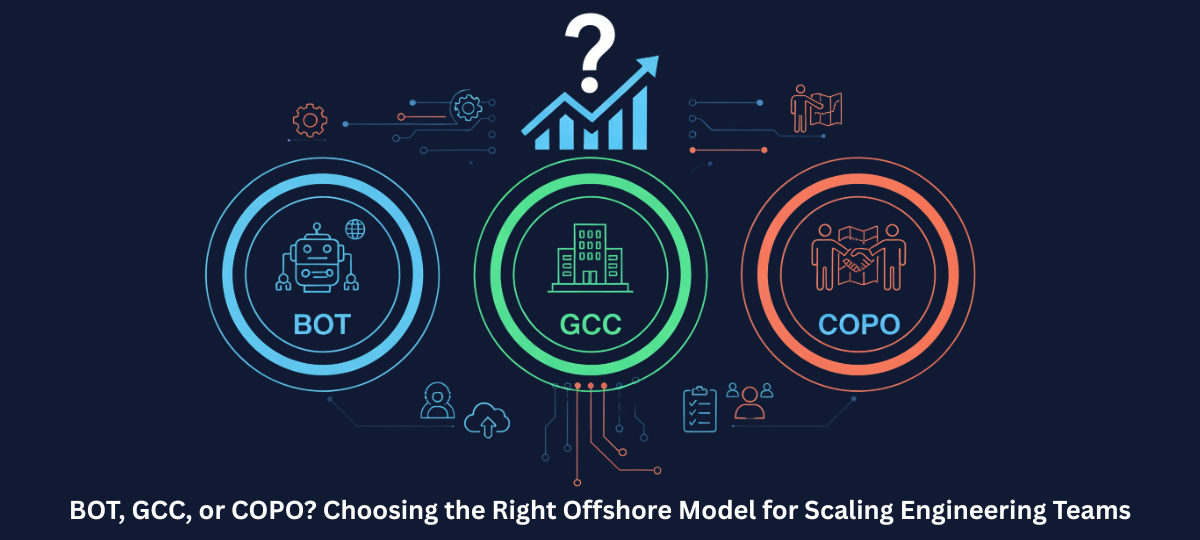

In 2026, scaling engineering teams is no longer just a hiring challenge — it is a strategic decision that shapes how fast a company can innovate, launch products, and compete globally. As digital transformation accelerates across industries, businesses are increasingly turning to offshore development models to expand engineering capacity, access global tech talent, and build resilient distributed teams.
However, choosing the right offshore structure is critical. The most commonly adopted models today are:
- Build-Operate-Transfer (BOT) model
- Global Capability Center (GCC)
- COPO (Company-Owned, Partner-Operated) model
Each offshore engagement model offers a different balance of control, scalability, operational responsibility, and long-term strategic alignment. This guide explores how these models work, when to choose each, and how to align your offshore strategy with business growth.
Why Offshore Engineering Models Matter More Than Ever
The global demand for skilled software engineers, AI specialists, cloud architects, and DevOps professionals continues to outpace supply in many developed markets. Organizations are under pressure to:
- Accelerate product development cycles
- Build scalable digital platforms
- Adopt AI and cloud-native architectures
- Expand engineering capacity without delays
As a result, enterprises are investing in:
- Offshore development center (ODC) setup
- Dedicated offshore engineering teams
- Global engineering hubs
- Captive offshore centers
- IT staff augmentation services
But offshore success depends heavily on choosing the right operating model.
Understanding the Build-Operate-Transfer (BOT) Model
The Build-Operate-Transfer (BOT) model is a structured offshore approach where a local partner establishes and manages an offshore development center on behalf of a client before eventually transferring ownership.
In the early stages, the offshore partner handles hiring, infrastructure setup, compliance, payroll, and operational management. Over time, control and ownership transition to the client organization, transforming the center into a captive entity.
The BOT model is particularly attractive to organizations entering a new geography for the first time. It allows companies to leverage local expertise while gradually building internal capabilities. Because the offshore partner manages regulatory requirements and talent acquisition during the initial phase, companies reduce early operational complexity.
Enterprises that envision long-term offshore ownership but prefer a phased approach often find the BOT offshore model ideal. It combines structured governance with the flexibility to evolve into a fully integrated global engineering center.
Global Capability Center (GCC): Building a Captive Offshore Hub
A Global Capability Center (GCC), often referred to as a captive offshore center, is a fully owned subsidiary established in another country to manage engineering, product development, innovation, or shared services.
Unlike traditional outsourcing, a GCC functions as an extension of the parent company. Teams operate under the same brand, processes, culture, and strategic objectives. Many multinational corporations operate GCCs in regions known for strong technical talent ecosystems.
A GCC provides maximum control over intellectual property, engineering processes, and organizational culture. It is especially suited for enterprises seeking to build a long-term global engineering footprint. Companies leveraging this model often use their GCC not just for development, but also for R&D, AI innovation, cybersecurity operations, and digital transformation initiatives.
However, establishing a Global Capability Center requires deep commitment. It involves understanding local regulations, setting up legal entities, building HR capabilities, and managing governance structures internally. Organizations that pursue this path typically have a long-term vision for sustained offshore growth and internal leadership presence.

Choose the Right Offshore Model for Scalable Engineering Growth
Confused between BOT, GCC, and COPO? Discover which offshore model aligns best with your business goals, budget, and long-term scaling strategy for building high-performing engineering teams.
COPO: Company-Owned, Partner-Operated Model
The COPO offshore model (Company-Owned, Partner-Operated) is emerging as a hybrid solution that balances ownership and operational efficiency.
In a COPO structure, the offshore entity is owned by the client company, but daily operations — including HR, recruitment, administrative management, and compliance — are handled by a trusted offshore partner. This creates a collaborative model where strategic control remains with the enterprise while operational execution is streamlined.
The COPO model is gaining popularity among growth-stage and enterprise organizations seeking to expand engineering teams rapidly without fully managing local administrative complexities. It provides ownership and strategic alignment similar to a GCC while maintaining operational agility similar to managed offshore services.
For companies that want strong IP protection and cultural integration without building a full local management structure from scratch, COPO offers a modern and scalable offshore delivery model.
Key Differences Between BOT, GCC, and COPO
While all three models support offshore engineering expansion, they differ in approach and governance philosophy.
The BOT model emphasizes phased transition. It is best suited for companies that want to test offshore operations before assuming full ownership.
The GCC model focuses on full control from the outset. It aligns with organizations building permanent global technology hubs integrated deeply into core strategy.
The COPO model blends ownership with operational delegation. It allows companies to scale engineering teams efficiently while relying on a partner’s local expertise.
Understanding these structural differences helps organizations align offshore strategy with internal capabilities and long-term business goals.
When to Choose Each Offshore Model
Choosing the right offshore model depends on your company’s maturity, risk tolerance, and strategic objectives.
Organizations entering a new offshore market with limited local expertise often prefer the BOT model. It enables structured expansion while minimizing early operational exposure.
Enterprises with established global operations and strong governance frameworks frequently opt for a Global Capability Center. This model supports deep integration, innovation, and long-term engineering excellence.
Companies seeking a balanced approach — with ownership but reduced administrative burden — gravitate toward the COPO model. It offers speed, flexibility, and structured scalability without the complexities of building everything independently.
The right decision ultimately depends on how you view offshore expansion: as a tactical hiring solution or as a strategic global capability initiative.
Offshore Development Center Trends in 2026
Offshore development strategies have evolved significantly. Today, organizations are not merely outsourcing tasks; they are building global engineering ecosystems.
Key trends shaping offshore models include:
- Growth of AI and machine learning teams in offshore hubs
- Expansion of cloud engineering and DevOps capabilities globally
- Increased focus on cybersecurity and compliance readiness
- Adoption of hybrid offshore models combining GCC and partner support
- Greater emphasis on culture alignment and cross-border collaboration
Companies that treat offshore centers as innovation engines — rather than cost-saving units — see stronger long-term impact.
Strategic Factors to Consider Before Scaling Offshore
Before committing to BOT, GCC, or COPO, organizations should evaluate several strategic dimensions.
Talent ecosystem strength in the target geography plays a crucial role. Regions with strong engineering education systems and vibrant tech communities offer sustainable growth opportunities.
Time zone alignment and cultural compatibility influence collaboration effectiveness. Distributed engineering teams succeed when communication frameworks are clearly defined.
Data security, IP protection, and regulatory compliance must be prioritized. Offshore expansion should strengthen governance, not weaken it.
Leadership presence also matters. Whether through local management hires or partner oversight, offshore teams require structured leadership to ensure alignment with business objectives.
Finally, scalability planning is essential. Offshore engineering expansion should be designed with growth in mind — supporting everything from small agile pods to large cross-functional teams.
Final Thoughts: Aligning Offshore Strategy with Business Vision
BOT, GCC, and COPO are not competing models — they are strategic pathways. The right choice depends on where your organization stands today and where it intends to go.
If your goal is gradual offshore ownership with reduced early complexity, the Build-Operate-Transfer model provides structure and flexibility.
If you envision a permanent global innovation hub fully embedded in your organization, a Global Capability Center offers maximum integration and control.
If you seek ownership with operational agility, the Company-Owned, Partner-Operated model strikes a powerful balance.
In 2026, scaling engineering teams is not just about increasing headcount. It is about building distributed capabilities that accelerate innovation, strengthen resilience, and support long-term digital growth. Choosing the right offshore model is a foundational step in that journey.
Related Hashtags:
#OffshoreDevelopment #GlobalCapabilityCenter #BOTModel #COPO #ScalingEngineering#OffshoreDevelopmentCenter#GlobalEngineering#SoftwareDevelopment #DigitalTransformation #MetaDesignSolutions