

 MetaDesign Solutions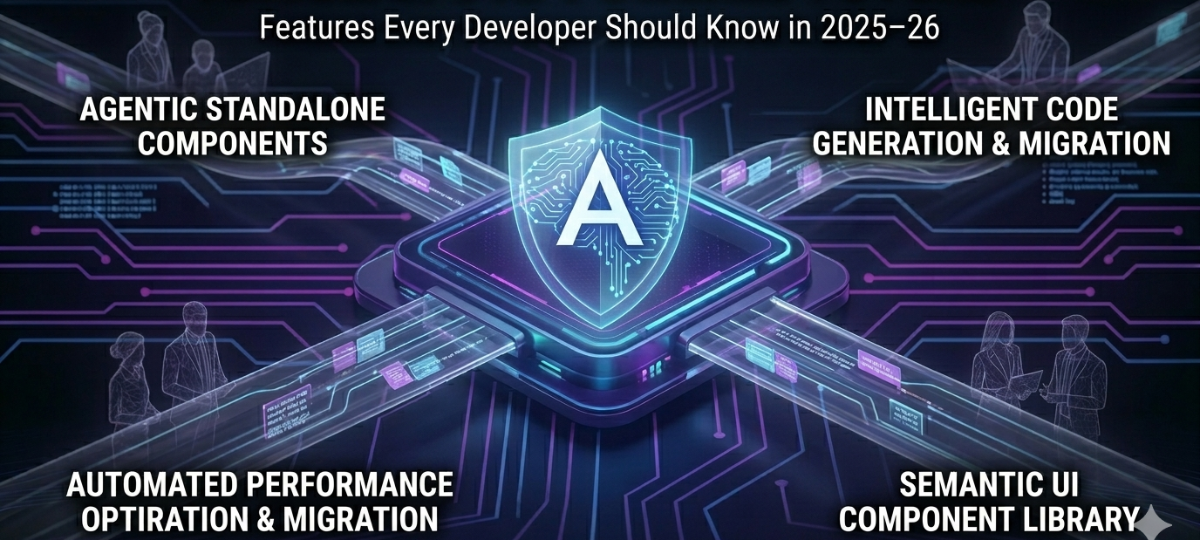

Angular has always been about structured, scalable development. But with v20 through v21, something bigger is happening — the framework is weaving AI directly into how developers write, test, and ship code. At Metadesign Solutions, we’ve been tracking these shifts closely, and a few features stand out as genuinely game-changing for any serious Angular team.
FEATURE 01 — The Angular MCP Server: AI That Knows Your Code
Introduced in Angular v20.2 and expanded in v21, the Angular MCP (Model Context Protocol) Server is one of the most practical AI integrations yet. Run ng mcp from your CLI and your AI coding agent — whether Cursor, Gemini CLI, or another tool — can now “see” your existing components, services, and project structure.
That means no more generic, pattern-mismatched AI suggestions. The LLM generates code that follows your codebase’s conventions and the latest Angular standards from day one. Angular v21 ships with seven stable and experimental MCP tools, including a modernize tool that helps migrate decorator-based patterns to the newer signal-based APIs automatically. It also bundles an AI Tutor mode — just prompt “Start AI Tutor” in your editor and get an interactive learning assistant scoped to your project.
FEATURE 02 — Signal Forms: Reactive State Without the Boilerplate
Angular v21 ships Signal Forms as an experimental API that completely reimagines how form state works. Instead of wrestling with FormGroup, valueChanges subscriptions, and the dreaded takeUntil(this.destroy$) pattern, form state is now a signal — reactive, type-safe, and composable by default.
This isn’t just a developer-experience win. As AI code generation tools become more prominent in Angular workflows, Signal Forms are already being treated as the target output — meaning LLMs trained on Angular best practices will generate signal-based forms going forward, reducing the gap between AI output and production-ready code.
FEATURE 03 — AI Config Files: Teaching AI Your Project’s Rules
Starting with Angular CLI v20.2, scaffolding a new project asks whether to include an AI configuration file. This file codifies your project’s rules — things like “always use standalone components,” “never use any,” “use signals for state management,” and “implement lazy loading for feature routes” — so every AI tool you use knows the house rules from the start.
You can generate this file at any time with a single CLI command, and it integrates directly with Cursor, GitHub Copilot, and other editors. Think of it as a prompt system that runs silently alongside every code generation session, keeping AI suggestions aligned with your standards. The config file is just text — review it, extend it with your team’s conventions, and commit it to your repo.
FEATURE 04 — Zoneless Angular + Genkit Integration
Angular v20.2 made zoneless change detection stable, and v21 makes it the new default for generated projects. Zone.js is gone. Change detection is now driven entirely by signals — producing smaller bundles, simpler debugging, and better performance in AI-heavy applications where state can update rapidly from streaming LLM responses.
On the integration side, Angular’s official AI guidance now centers on Genkit — Google’s open-source, model-agnostic toolkit. Genkit works with Gemini, OpenAI, Anthropic, and other models through a unified API, enabling streaming chat interfaces, agentic workflows, and real-time AI capabilities directly within Angular applications. For businesses partnering with an experienced Angular development company, the combination of Zoneless architecture, Signals, and Genkit represents Angular’s recommended stack for building modern AI-powered applications.
FEATURE 05 — angular.dev/ai: The Official AI Dev Hub
Angular now has a dedicated resource at angular.dev/ai that centralises best practices, code samples, starter kits, and design patterns specifically for building AI-powered Angular applications. It includes fine-tuned prompts for popular LLMs, custom rule files for code editors, and step-by-step guides for integrating Gemini, Firebase AI Logic, and the Gemini API directly.
The Angular team also launched the Web Codegen Scorer — a quality evaluation tool that benchmarks how well LLMs generate modern Angular code. This directly improves how AI tools handle new APIs like Signal Forms from day zero, rather than needing months for training data to catch up.

Automate Smarter with Enterprise Conversational AI
Ready to streamline complex workflows and enhance operational efficiency? Discover how enterprise conversational AI solutions can automate business processes, reduce costs, and drive intelligent decision-making at scale.
How We at Metadesign Solutions Put This Into Practice
At Metadesign Solutions, we don’t just track these changes — we build with them. These aren’t abstract improvements; they directly shape how our team ships Angular projects for clients.
- We configure the Angular MCP server as standard setup on every project, so all developers — and AI assistants — work with full project context from the first commit.
- Our teams have adopted Signals-first architecture across components and forms, aligning with where Angular (and AI code generation) is clearly headed.
- We commit AI config files to every repo, encoding our code standards so that AI-generated code is consistent with our conventions, not a cleanup task.
- We use Genkit with a zoneless setup for client projects that require real-time AI features, taking advantage of Angular’s cleaner change detection for streaming data.
- We track angular.dev/ai for updated prompts and patterns, ensuring our AI-assisted workflows reflect current best practices rather than stale training data.
Angular’s AI story is no longer about bolting AI onto an existing app — it’s about an ecosystem that’s actively rethinking the development workflow itself. The MCP server, Signal Forms, AI config files, and the new zoneless default aren’t isolated features. They’re a coherent direction: a framework that helps both developers and their AI tools write better Angular, faster.
Whether you’re migrating an existing codebase or starting fresh in 2026, these are the features worth understanding deeply — not just using once and forgetting.
Related Hashtags:
#Angular#Angular2025#AngularDevelopment#WebDevelopment#FrontendDevelopment#AIDevelopment#AIInWebDevelopment#AIpoweredApps#JavaScriptFramework#ModernWebApps#EnterpriseAngular#CloudNativeApps#DeveloperTrends#FutureOfWeb#SoftwareDevelopment