

 MetaDesign Solutions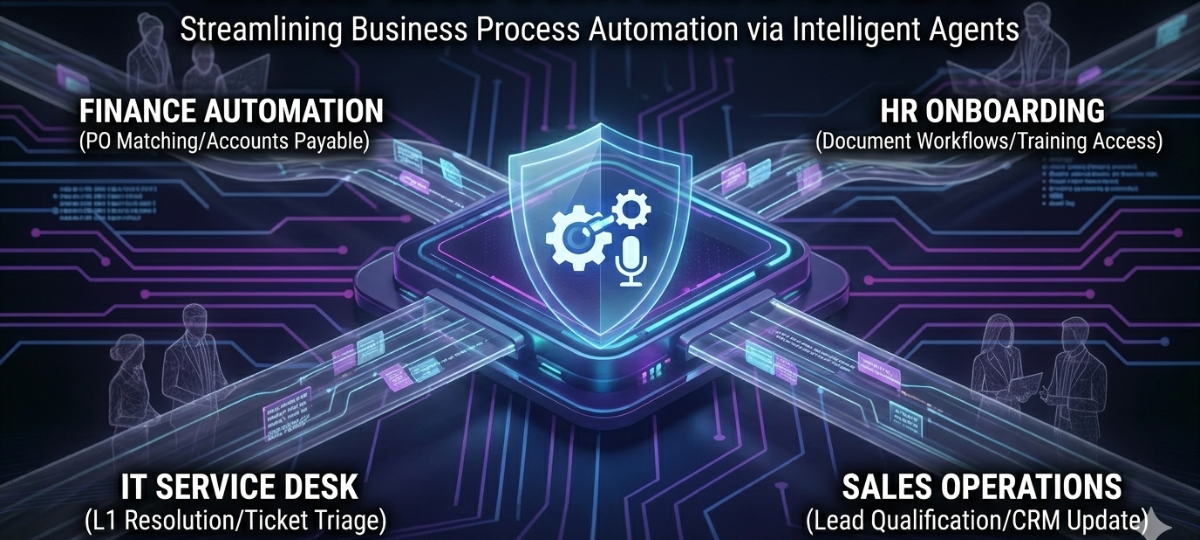

Enterprise automation is no longer limited to backend workflows and robotic process automation. In 2026, businesses are transforming how employees and customers interact with systems through Conversational AI. Instead of navigating complex dashboards or submitting manual requests, users now engage with intelligent virtual assistants that understand intent, process data, and execute tasks instantly.
Conversational AI for enterprise automation combines natural language processing (NLP), machine learning, large language models (LLMs), and workflow orchestration to automate business processes through voice and chat interfaces. It transforms static systems into intelligent, interactive platforms.
What Is Conversational AI in Enterprise Context?
Conversational AI refers to AI-powered systems that can understand, interpret, and respond to human language in a contextual and meaningful way. In enterprise environments, it goes beyond simple chatbots.
Modern enterprise conversational AI solutions can:
- Trigger automated workflows
- Integrate with CRM, ERP, and HR systems
- Retrieve and process enterprise data
- Execute approvals and task assignments
- Generate reports and summaries
- Escalate complex scenarios to human teams
This makes conversational AI a powerful interface layer for enterprise software systems.
Why Enterprises Are Adopting Conversational AI
Organizations are under pressure to improve operational efficiency while reducing manual workload. Traditional automation systems require users to interact with multiple platforms. Conversational AI simplifies this by acting as a unified interface.
Enterprises are adopting AI-driven automation to:
- Reduce operational bottlenecks
- Accelerate internal approvals
- Improve employee productivity
- Enhance customer service automation
- Enable 24/7 support
- Streamline cross-department communication
By combining conversational interfaces with intelligent backend workflows, businesses create a seamless automation ecosystem.
Key Components of Enterprise Conversational AI
Successful enterprise AI automation platforms rely on multiple technologies working together.
Natural Language Processing enables systems to understand user intent. Large Language Models generate contextual responses. API integrations connect conversational interfaces with enterprise software such as Salesforce, Dynamics 365, SAP, or custom ERP systems.
Workflow orchestration engines ensure that conversations trigger structured business processes rather than isolated responses.
Security layers enforce authentication, authorization, and compliance controls.
Together, these components enable scalable and secure conversational automation.
Use Cases of Conversational AI in Enterprise Automation
Conversational AI is transforming multiple enterprise functions.
HR and Employee Self-Service
Employees can request leave approvals, access policy documents, update payroll information, or check benefits through AI assistants. Instead of submitting tickets manually, HR automation becomes instant and conversational.
IT Service Management
Enterprise chatbots integrated with ITSM systems can create support tickets, reset passwords, provide troubleshooting guidance, and escalate incidents automatically.
Finance and Procurement Automation
Conversational AI systems can process purchase requests, track invoices, generate financial summaries, and initiate approval workflows. This reduces delays and manual review cycles.
Sales and CRM Automation
Integrated with CRM platforms, AI assistants can retrieve customer data, update sales pipelines, schedule follow-ups, and provide performance insights.
Customer Support Automation
AI-powered enterprise chatbots handle high volumes of queries, route requests intelligently, and provide contextual answers using retrieval-augmented generation (RAG) models.
Conversational AI vs Traditional Chatbots
Traditional rule-based chatbots rely on predefined scripts and limited keyword recognition. They often fail when conversations deviate from expected patterns.
Enterprise conversational AI platforms use advanced LLM-based architectures, allowing them to:
- Understand intent rather than just keywords
- Maintain conversation context
- Integrate dynamically with backend systems
- Generate natural responses
- Learn from interaction patterns
This shift from scripted automation to intelligent dialogue significantly enhances automation capabilities.

Automate Smarter with Enterprise Conversational AI
Ready to streamline complex workflows and enhance operational efficiency? Discover how enterprise conversational AI solutions can automate business processes, reduce costs, and drive intelligent decision-making at scale.
The Role of Generative AI in Enterprise Automation
Generative AI enhances conversational automation by enabling:
Dynamic content generation
Intelligent document summarization
Automated email drafting
Meeting recap creation
Personalized response generation
When implemented with the expertise of a trusted Generative AI Development Company, generative AI integrates seamlessly with enterprise systems to reduce manual effort, accelerate workflows, and significantly improve operational efficiency.
Benefits of Conversational AI for Enterprises
Organizations implementing conversational AI for automation experience:
- Improved productivity
- Reduced manual errors
- Faster decision-making
- Enhanced user experience
- Lower operational costs
- Scalable automation across departments
Most importantly, conversational AI provides a unified interaction layer across enterprise systems.
Security and Compliance in Enterprise AI Automation
Enterprise-grade conversational AI must prioritize data privacy and compliance.
Secure AI systems include:
- Role-based access control
- Encrypted communication channels
- Audit trails
- Compliance with industry regulations
- Human-in-the-loop governance
Responsible AI implementation ensures automation does not compromise security.
Conversational AI and Cloud-Native Architecture
Modern enterprise automation systems are built using cloud-native architecture. Conversational AI integrates seamlessly with:
- Microservices-based systems
- API-first platforms
- Containerized environments
- Kubernetes orchestration
CI/CD pipelines
This ensures scalability and resilience across global operations.
The Future of Conversational Enterprise Automation
The next evolution of conversational AI includes:
- Autonomous AI agents managing end-to-end workflows
- Predictive automation using data analytics
- Emotion-aware enterprise assistants
- Multilingual AI for global enterprises
- Voice-first automation interfaces
Conversational AI will become the primary interaction layer for enterprise software.
Final Thoughts
Conversational AI is redefining enterprise automation. It transforms static systems into intelligent, interactive environments where employees and customers can execute tasks through natural language.
In 2026 and beyond, enterprise automation will not be about dashboards and forms — it will be about intelligent conversations driving real-time action.
Organizations investing in conversational AI today are building scalable, efficient, and future-ready automation ecosystems.
Related Hashtags:
#ConversationalAI #EnterpriseAI #AIAutomation #IntelligentAutomation #BusinessProcessAutomation #AIWorkflow #GenerativeAI #DigitalTransformation #EnterpriseTechnology #MetaDesignSolutions