

 MetaDesign Solutions
Introduction: Why Global Enterprises Are Re-Thinking Offshore Expansion
As enterprises expand globally, building engineering and delivery teams offshore is no longer just about lowering costs. In 2026, companies are focused on speed, ownership, scalability, and risk reduction.
Traditional outsourcing models often fall short:
- Staff augmentation lacks long-term ownership
- Full acquisitions carry high upfront risk
- Captive centers take too long to set up
- Vendors create long-term dependency
This is why global enterprises increasingly adopt the Build-Operate-Transfer (BOT) model—a structured approach that combines the speed of outsourcing with the control of in-house teams.
This guide explains what the BOT model is, how it works, when it makes sense, and why it has become a preferred strategy for global organizations building offshore capabilities.
What Is the Build-Operate-Transfer (BOT) Model?
The Build-Operate-Transfer (BOT) model is an offshore delivery strategy where a specialized partner:
- Builds a dedicated offshore team and infrastructure
- Operates it on your behalf to achieve stability and performance
- Transfers full ownership to your organization once maturity is reached
Unlike traditional outsourcing, BOT is designed for long-term ownership, not perpetual vendor dependency.
At the end of the BOT lifecycle, the offshore team becomes your captive delivery center, fully aligned with your culture, processes, and goals.
Why the BOT Model Exists
Global enterprises face three major challenges when expanding offshore:
- Speed vs Control – Building in-house teams takes time
- Risk – Early hiring, compliance, and operations are costly mistakes
- Scalability – Teams must grow without disruption
The BOT model solves this by allowing enterprises to:
- Enter new geographies quickly
- De-risk early-stage operations
- Validate offshore delivery before ownership
- Retain IP, talent, and operational control
The Three Phases of the BOT Model Explained
1. Build Phase: Laying the Foundation
In the Build phase, the BOT partner sets up everything required for a dedicated offshore operation.
This includes:
- Talent acquisition and onboarding
- Infrastructure and tooling
- Security and compliance frameworks
- Delivery processes and governance
- Cultural alignment with the parent organization
For global enterprises, this phase removes the complexity of local hiring laws, payroll, compliance, and office setup—allowing leadership to focus on strategy, not logistics.
2. Operate Phase: Stabilizing and Scaling Delivery
Once the team is established, the partner operates the offshore center as an extension of your organization.
During this phase:
- Teams deliver real production work
- Performance metrics are defined and tracked
- Processes are optimized for scale
- Knowledge transfer happens continuously
- The enterprise retains visibility and control
This phase is critical. It allows enterprises to test real-world performance before committing to full ownership.
3. Transfer Phase: Full Ownership Without Disruption
In the final phase, ownership of:
- Team members
- Infrastructure
- Processes
- IP and assets
is transferred to the enterprise.
The result is a fully operational captive offshore center, built with lower risk, faster timelines, and proven performance.

Looking for a Smarter Global Expansion Model?
Understand how the Build-Operate-Transfer model supports scalable global expansion, operational efficiency, and smooth transition of ownership for large enterprises.
BOT vs Traditional Outsourcing vs Captive Centers
Understanding the difference is essential for decision-makers.
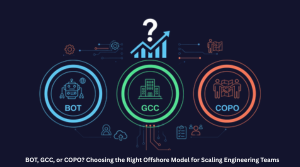
Traditional outsourcing focuses on delivery contracts and SLAs, often creating long-term dependency. Captive centers provide control but require high upfront investment and long setup timelines.
The BOT model combines the strengths of both:
- Faster setup than captives
- More ownership than outsourcing
- Lower initial risk
- Clear exit strategy
This makes BOT particularly attractive for digital product engineering, AI platforms, and enterprise modernization initiatives.
When Does the BOT Model Make Sense?
The BOT model is ideal when:
- You plan long-term offshore investment
- IP ownership is critical
- You want to build internal capability, not dependency
- Speed-to-market matters
- You are entering a new geography
It is commonly used by:
- SaaS and product companies
- Fintech and regulated enterprises
- Technology-led global organizations
- Enterprises building centers of excellence
Key Benefits of the BOT Model for Global Enterprises
Risk Mitigation
Early-stage operational risk is absorbed by the BOT partner.
Faster Market Entry
Enter new regions without lengthy legal and operational delays.
Cost Optimization
Avoid heavy upfront investments while maintaining long-term cost efficiency.
Talent Retention
Teams are built with long-term ownership in mind, improving retention.
IP and Process Ownership
Unlike outsourcing, all IP and delivery knowledge ultimately belongs to you.
Common BOT Model Mistakes to Avoid
Not all BOT engagements succeed. Common pitfalls include:
- Unclear transfer timelines
- Poor governance and KPIs
- Treating BOT like staff augmentation
- Weak cultural alignment
- No long-term ownership strategy
A successful BOT model requires clear intent, structured execution, and an experienced partner.
Why Choosing the Right BOT Partner Matters
A BOT partner is not just a vendor—they are temporarily running a critical part of your future organization.
The right partner should:
- Understand enterprise delivery models
- Build teams for ownership, not dependency
- Offer transparency at every stage
- Have experience with global clients
- Support a clean, frictionless transfer
MetaDesign Solutions’ Approach to the BOT Model
At MetaDesign Solutions, we help global enterprises implement the Build-Operate-Transfer model with a product-engineering mindset.
Our BOT engagements focus on:
- Dedicated offshore delivery centers
- Custom product engineering teams
- AI, cloud, and high-performance systems
- Long-term scalability and ownership
We don’t just build teams—we build future-ready offshore organizations.
👉 Considering a BOT strategy for your enterprise?
Schedule a confidential consultation with our experts:
🔗 https://calendly.com/amit-mds
Conclusion: BOT Is a Strategic Path to Global Scale
The Build-Operate-Transfer model is no longer a niche outsourcing strategy. In 2026, it is a strategic framework for enterprises that want to scale globally without sacrificing control, quality, or speed.
By combining:
- The agility of outsourcing
- The stability of captive centers
- A clear path to ownership
The BOT model offers a future-proof approach to offshore expansion.
For global enterprises serious about long-term growth, BOT is not just an option—it’s a competitive advantage.
Related Hashtags:
#BuildOperateTransfe r#BOTModel #OffshoreDevelopment #GlobalDelivery #CaptiveCenter #EnterpriseSoftware #SoftwareEngineering
#MetaDesignSolutions